
The Chosen Episode Guide: Season 2, Episode 5
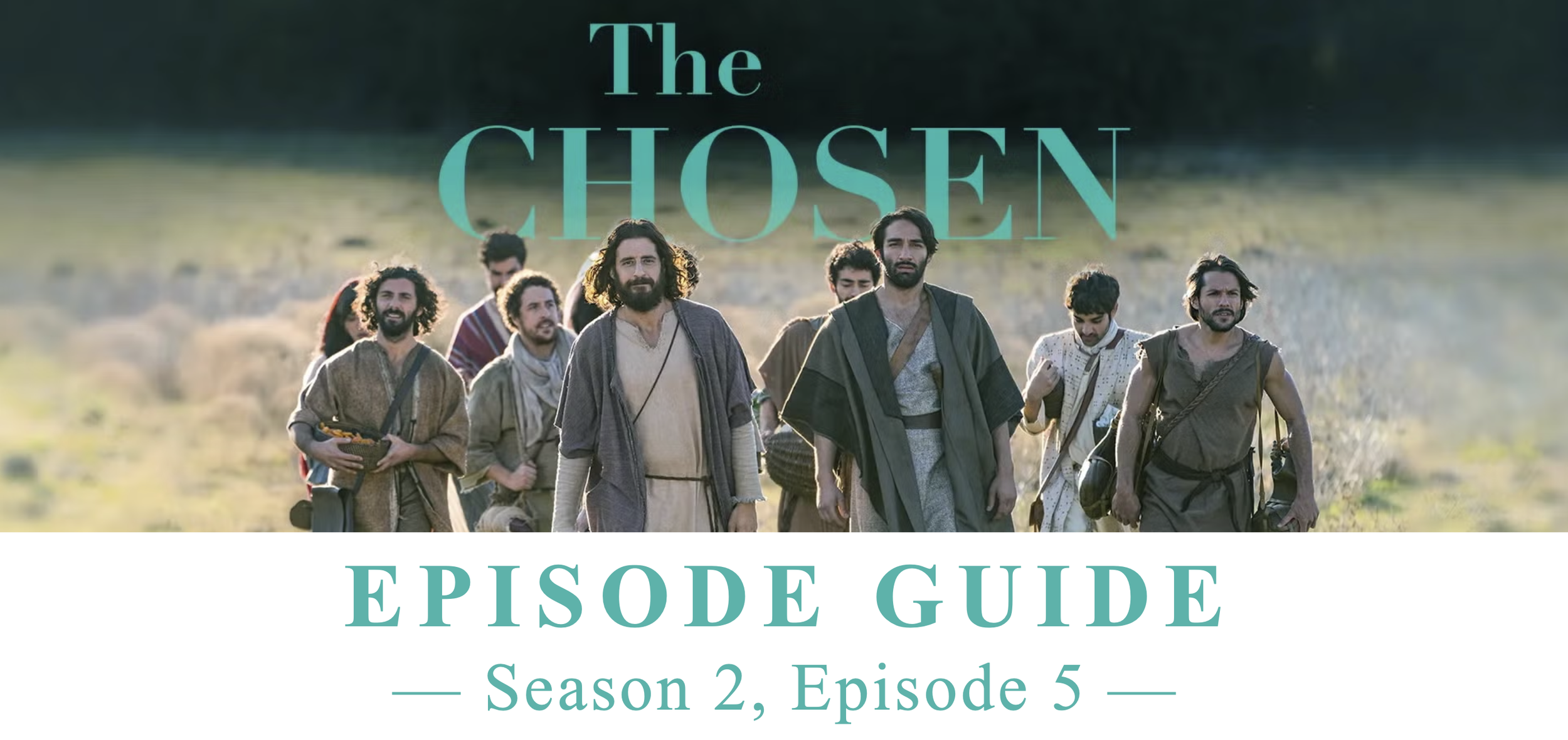
S2, E5
This is an episode that is deeply speculative. Additionally John the Baptists character seems to be a bit silly. I’m guessing the people represented in the pages of the Bible knew how to have fun, but it seems to me that John is presented in much more reverent terms than seen here. Though these things are true, there are some helpful things along the way as well.
Biblical: What We Find in Scripture
Immediately after the title sequence, the man who had been healed at the pool of Bethesda is being questioned by the Pharisees. While there are many details added in the chosen, this happened and can be read about in John 5:10ff.
Unbiblical: What Contradicts Scripture
None
Extra-biblical: What Is Made Up but Doesn’t Contradict Scripture
In the opening scene, where Mary Magdalene is picking persimmons, Mary sees some Roman soldiers. She hides from them, apparently in fear. This scene is not found in the pages of Scripture, and I am curious as to where the writers are going with it. Certainly the Jewish people did not like the occupation of Israel by the Romans, but there isn’t anything in the Bible that would suggest people were struck with terror at the sight of a Roman soldier.
As previously mentioned, Atticus is a made-up character for the chosen. His interaction with “Jesse”, the man healed at the pool of Bethesda, is fictional. “Jesse” is here put in quotation marks because we are not told the name of the man in John 5, the only portion of the gospels that records his healing.
The fireside scene of “Simon Z”, called in Scripture Simon the Zealot to distinguish him from Simon Peter, and his interaction with the demon-possessed man is not in the biblical record. Interestingly, Simon Z uses the phrase “waterless places” to speak of where the demon would go if the possessed man were to die. The phrase “waterless places” is used by Jesus in Matthew 12:43 and Luke 11:24. In the Bible, Jesus is the only one to use this term.
Jesus’ interaction with John the Baptist is not found in the Bible; however, it is based upon some things that are recorded in Scripture. Herodias was the wife of Philip, the brother of Herod Antipas (Mt. 14:3). Philip had indeed married Herodias (Mt. 14:3; Mk. 6:17). And John the Baptist had spoken out publicly against this (Mt. 14:4; Mk. 6:17). The continuing conversation with Jesus and John isn’t in the Bible either. However, I find this conversation odd. Jesus never seemed to have any problem confronting sin, but here is represented that way. Certainly, Jesus didn’t pick every fight he could have, but this seems a little out of character. John’s statement that he was miraculously conceived by two old people to pave the way for Jesus is also a true statement (Lk. 1).
Ramah is a fictional character. Obviously, the scene where Mary Magdalene is teaching her to read isn’t from the Bible. Although Mary’s statement that some letters in Hebrew are “swallowed up” by others is accurate. This part of learning Hebrew is very difficult. Matthew and Thomas’s interaction during this scene is also fictional.
This episode harkens back to previous episodes where Jesus casts demons out from Mary Magdalene. Luke 8:2 records that 7 demons were cast out from Mary Magdalene, but when the demon-possessed man shows up in the camp and calls Mary Lilith, this is drawing on things outside of Scripture. Mary is never called Lilith in the Bible. Scripture records that Jesus could cast out demons that Jesus could not, but it never records these events with a demon-possessed man named Caleb.
There is also no biblical record of how Simon the Zealot became a disciple. His name occurs in the lists of the disciples of Jesus in Matthew 10, Mark 3, and Luke 6. Several of the scenes include parts of Simon the Zealot’s calling. All of the scenes whereby “Simon Z” is called to be a disciple are speculation.
While the Pharisees questioned Jesus and the man healed at the pool of Bethesda, there is nothing in the Bible that records any filing of formal complaints. This scene with Shmuel trying to follow up on formal charges was written solely for the Chosen.
Jethro is not a biblical character in the Gospels. All the interactions of Mary and Jethro are not taken from the biblical record but rather written for the show.
The closing scenes of the show where Jesus is practicing a sermon, the disciples and others are gathered around a fire in camp, the Pharisees are plotting to try and figure out who Jesus is, Mary’s escape to go see someone named Jethro, and Peter and Matthew’s departure to find Mary are all fictitious.
Helpful: What We Might Be Helpful To the Watcher
In the scene where the demon-possessed man wanders into the camp of the disciples, Jesus arrives and immediately casts out the demons from the man. While this story is fictional, it shows the power of Jesus over demons. We should expect that Jesus had this kind of power over demons.
In Jesus’ calling of Simon the Zealot, he throws Simon’s dagger into the lake. This scene is fictional and doesn’t line up with some of the events we see in the Bible as there are times when the disciples have swords. However, there is something helpful here. Jesus called the disciples to leave whatever lives they were living to follow him. Mary did follow Jesus. Peter, as well as others, gave up fishing. Matthew left the tax booth. We should expect that Simon was expected to give up his life of political aspirations as a Zealot. Jesus had much bigger plans for “Simon Z” than the political aspirations he had previously.
Dangerous: Things That Have Been Added That Might Be Dangerous to Accept as Fact
I believe that there is a danger inherent in every episode, and for that reason, I’m including this suggestion in every episode guide. The danger is assuming that the things in the episodes of the Chosen that are not in the Bible are true, part of the biblical record. In order to avoid this danger, I would encourage everyone who watches the Chosen to compare it to the biblical record. IN part, this is because most of what is in each episode of the Chosen is not found in the Bible. There is more speculation here than actual events recorded in the Bible. If you want a harmony of all of the gospels in chronological order to aid this, then I would recommend purchasing a copy of One Perfect Life by John MacArthur. It is a compilation of all of the gospel records in order of the events as best as we can understand.
Anachronisms and Errors: Things that are out of place regarding the time, etc.
There are a few, but they are inconsequential.