

BLOG
The Chosen Episode guide: season 2, Episode 8
This final episode of season 2 leads us right up the Sermon on the Mount. Sadly, rather than showing us Jesus teaching there, this episode presents us with almost entirely fictional material that leads right up to the sermon on the mount without showing us anything of what the Scriptures actually record.
S2, E8
This final episode of season 2 leads us right up the Sermon on the Mount. Sadly, rather than showing us Jesus teaching there, this episode presents us with almost entirely fictional material that leads right up to the sermon on the mount without showing us anything of what the Scriptures actually record.
Biblical: What We Find in Scripture
The crowd gathered when Jesus gave the sermon on the mount would have been large. Thousands of people likely had gathered to hear him speak, though no number is recorded in the Gospels (Matthew 1:1). The crowd pictured in this episode is likely much smaller than the crowd would have been.
Unbiblical: What Contradicts Scripture
I want to be careful here, and at the same time I want to admit that I am about to be a little nitpicky. In Matthew, the 12 disciples aren’t recorded until chapter 10, while the sermon on the mount happens in chapters 5-7. However, in Luke 6 the 12 are recorded before the sermon on the mount. Luke is much more strict regarding the sequence of events than Matthew, though Matthew is generally following a chronological approach. I am inclined to think that Luke is probably more specific here in indicating that all 12 had been called prior to the sermon on the mount.
Extra-biblical: What Is Made Up but Doesn’t Contradict Scripture
As seems to be the MO for the chosen, the opening scene, which appears to be a flashback to the previous experiences of Judas, isn’t found anywhere in the Bible. As we have already seen from previous episodes, the Bible doesn’t really provide any detailed background information about the disciples. We might know what they didn’t before they followed Jesus, but almost no other details are given.
The next scene with the disciples chopping wood at camp isn’t in the biblical record. There is also nothing in the biblical record of the disciples trying to find locations for Jesus’ sermons, providing security, worrying about hecklers, etc. The Bible seems to show more that wherever Jesus went, crowds would form. And as the crowds formed, Jesus would heal, teach, and even feed them. The conversation of the women in the tent is also part of what is made up for this episode.
The scene in the pub where Judas is discussing the purchase of the field that has a salt mine in it is fictional. Judas deceptive and greedy character is documented in the gospels, but how that character was formed is not known.
The three disciples who were scoping out a place for Jesus to “preach” aren’t from any biblical account. This includes the subsequent scene in the pub where they are trying to negotiate a price for the place of the sermon on the mount.
Again, while we know that the Pharisees were plotting against Jesus, we aren’t really shown anything in the Bible of their plot except what they did publicly. With rare exception, Pharisees are not named in the Gospels. Shmuel is a fictional rabbi, and all of his interactions with other rabbis are scenes made from the Chosen but are not drawn from the pages of the Bible. Shammai is a known rabbi as recorded in history, but not found in the Bible.
We are never told in the Bible that “notices”, which amount to flyers here in this episode, were ever circulated to announce Jesus coming to an area. In fact, this seems highly unlikely. Paper and ink were expensive commodities, and Jesus and the disciples were quite poor. Also, no indication is given in the Bible that Jesus used Matthew as some kind of Amanuensis. Clearly, this episode is in preparation for the sermon on the mount, but everything so far in this episode that leads up to the sermon on the mount is written solely for The Chosen and isn’t from the Bible.
The words of Jesus as he is practicing for the sermon on the mount are derived from the sermon on the mount. The reason I am putting it here is because we are not given any indication in the Bible that Jesus had a practice session before he gave the sermon. When Jesus closes the sermon on the mount by saying “if people want to find him, that they should look for those groups of people”, that is not recorded in the sermon on the mount at any point.
Matthew 1 seems to indicate that the crowd had already gathered when Jesus decided to go up on the mountain and preach. I’m inclined to think that Jesus’s “sermon” wasn’t pre-written, but rather given as a means of ministering to the crowd that had already gathered.
There is nothing in the Bible that would indicate that the women who were part of those who followed Jesus ever attempted to influence his apparel.
Helpful: What Might Be Helpful To the Watcher
None. While it seems strange to say that there is nothing helpful here, this section is devoted to those things that might help in terms of understanding the culture and times. To that end, there wasn’t anything in this episode that was helpful to that end.
Dangerous: Things That Have Been Added That Might Be Dangerous to Accept as Fact
I believe that there is a danger inherent in every episode and for that reason I’m including this suggestion in every episode guide. The danger is assuming that the things in the episodes of the Chosen that are not in the Bible are true, part of the biblical record. In order to avoid this danger, I would encourage everyone who watches the Chosen to compare it to the biblical record. In part, this is because most of what is in each episode of the Chosen is not found in the Bible. There is more speculation here than actual events recorded in the Bible. If you want a harmony of all of the gospels in chronological order to aid this, then I would recommend purchasing a copy of One Perfect Life by John MacArthur. It is a compilation of all of the gospel records in order of the events as best as we can understand.
Anachronisms and Errors: Things that are out of place regarding the time, etc.
N/A

The Chosen Episode Guide: season 2, Episode 7
It is disappointing that in an episode that is almost entirely fictional, the one part that is found in the Bible is glossed right over. Jesus begins teaching the disciples the Lord’s prayer, which fades away as soon as Jesus begins.
S2, E7
It is disappointing that in an episode that is almost entirely fictional, the one part that is found in the Bible is glossed right over. Jesus begins teaching the disciples the Lord’s prayer, which fades away as soon as Jesus begins.
Biblical: What We Find in Scripture
The conversation of the disciples when Jesus returns isn’t in the Bible, but in Matthew 6, Jesus does teach the disciples to pray in what we call “the Lord’s prayer.”
Unbiblical: What Contradicts Scripture
None
Extra-biblical: What Is Made Up but Doesn’t Contradict Scripture
As always, Quintas and Atticus are not characters found in the Bible. There is no indication in the Bible that signs were posted in seeking Jesus for questioning.
Simon Peter, Andrew, James, and John’s contest to see who would fish, and whether or not they were all to fish, isn’t in the Bible. Additionally, there is nothing in the Bible to indicate that Jesus had ever choreographed the disciples in preparation for any of his teachings. Rather, we often see Jesus giving last-minute instructions, like directing them to feed the crowds themselves at the feeding of the 5,000 and 4,000. Whatever conversations are later had in this episode while Peter and Andrew are fishing are fictional as well.
Rabbis Shmuel (Samuel) and Yusef (Joseph) aren’t named in Scripture, and this meeting of the rabbis in the opening minutes of this episode is not in the Bible. In fact, there are only 3 Pharisees that are named in the Bible, and the only one that occurs in the Gospels is Nicodemus. Saul (later Paul) and Gamaliel are both named in Acts. When these Pharisees then go to the Roman cohort, we can know that these events are fictional because none of the Pharisees, nor Romans, are named in the Bible.
The Roman plot to arrest Jesus, as well as his subsequent arrest, aren’t found in the Bible. The Jews, mainly by the Jewish religious leaders, are often found to be seeking to arrest Jesus, though this is mostly toward the end of Jesus’ ministry. The Romans seem largely unconcerned with Jesus. This
The fact that the arrest of Jesus is fictional means also that the subsequent argument of the disciples and Andrew’s accusation at Mary Magdalene are fictional and dramatized for this episode.
Jesus is asked, when he heals by declaring that sins are forgiven, who other than God has the authority to forgive sins. The answer, of course, is only God, but that is the point. However, because all of the events of this episode so far are fictional, the question asked in this way is also fictional.
Quintas is a fictional character; therefore, his conversation with Jesus is fiction as well.
The Ethiopian woman isn’t a biblical character.
Again, while Nicodemus plays a prominent role in The Chosen, he plays almost no role in the biblical record. Nicodemus is only found in the gospel of John, and only when he goes to Jesus by night to question him (Jn. 3), when he speaks up saying that Jesus deserves a hearing according to their law (Jn. 7), and in preparing Jesus’ body for burial (Jn. 19).
Helpful: What We Might Be Helpful To the Watcher
While Quintas is fictional, there is a helpful element here, though it isn’t exactly accurate in its application. Quintas tells Jesus that taking a tax collector, starting a “riot”, etc., are “bones.” Pilate had been sent to Israel by Rome because of his poor leadership in other areas of the empire, particularly allowing riots. The one thing Pilate couldn’t have on his hands was another riot. While that has nothing to do with Quintas, a fictional character, it does give insight into why Pilate may have been willing to give up Barabbas instead of Jesus.
Dangerous: Things That Have Been Added That Might Be Dangerous to Accept as Fact
I believe that there is a danger inherent in every episode, and for that reason, I’m including this suggestion in every episode guide. The danger is assuming that the things in the episodes of The Chosen that are not in the Bible are true, part of the biblical record. In order to avoid this danger, I would encourage everyone who watches The Chosen to compare it to the biblical record. IN part, this is because most of what is in each episode of The Chosen is not found in the Bible. There is more speculation here than actual events recorded in the Bible. If you want a harmony of all of the gospels in chronological order to aid this, then I would recommend purchasing a copy of One Perfect Life by John MacArthur. It is a compilation of all of the gospel records in order of the events as best as we can understand.
Anachronisms and Errors: Things that are out of place regarding the time, etc.
None
The Chosen Episode Guide: Season 2, Episode 6
There is a lot made up in this episode, but that doesn’t mean that there aren’t some helpful things here too.
S2, E6
There is a lot made up in this episode, but that doesn’t mean that there aren’t some helpful things here too.
Biblical: What We Find in Scripture
Though many details have been added, David did eat bread from the temple while fleeing from Saul. This is recorded in 1 Sam. 21.
While there is no record of the disciples having a conversation about breaking John the Baptist out of prison, John was imprisoned (Mt. 14:1-12; Mk. 6:14-29; Lk. 3:19-20).
Though the details seem to be very different in the chosen, the healing of the man with the withered hand is probably a very dramatized version of the healing found in Mt. 12:9-21; Mk. 3:1-12; and Lk. 6:6-11. All three gospel writers who record this, record the picking of wheat on the Sabbath as happening before the healing of the man with the withered hand in Mt. 12:1-8; Mk. 2:23-28, Lk. 6:1-5. In this episode,
Unbiblical: What Contradicts Scripture
None
Extra-biblical: What Is Made Up but Doesn’t Contradict Scripture
Matthew and Peter’s opening scene of waking up, making breakfast, and searching for Mary Magdalene isn’t from the Bible. Neither is there any clue in the Bible that Matthew may have been attracted to her. Not just the opening scene, but the continuing scenes of Matthew and Peter’s search for Mary are also written for the Chosen but not part of the biblical record.
Ramah is a fictional character never found in the pages of the Bible. Therefore, the conversation with Mary the mother of Jesus and Ramah is fictional.
Since both of the previous scenes involved searching and conversing about Mary Magdalene, it should be noted that there is no biblical record of Mary Magdalene disappearing and being searched for.
The scene with Mary gambling and drinking in a bar is entirely fictional.
The disciples counting the lentils, and James’ and John’s conversation about Simon and the Zealots is fiction.
The scene of the Shmuel and another rabbi in the temple trying to seek conviction against Jesus isn’t in the Bible. In fact, other than Nicodemus, there is no record of any religious leader being neither patient nor dismissive of Jesus. Very early on in Jesus’ ministry, the religious leaders seek to trap Jesus in his own words. The highest of religious leaders seem to have a problem with Jesus from very early on in his ministry.
Mary Magdalene’s return, probably obviously by this point, is made up for the video series.
Helpful: What We Might Be Helpful To the Watcher
While the disciples counting lentils is fictional, the reality that Jesus and the disciples were poor is clear from the pages of the Bible. So though fictional, it is helpful to remember that Jesus and the disciples were dependent upon others for their provision.
We see at several points in the gospels that the disciples struggled to understand what Jesus was teaching, and most likely doing as well. James’ and John’s conversation about their struggle to understand, while made up, is helpful in seeing this.
While there is no indication in the Bible that Mary Magdalene ever wavered in her obedience to Jesus, the point of these scenes involving her leaving, gambling and drinking, and being found by Matthew and Peter all make an important point. Jesus describes himself as gentle and lowly. He is patient with the repentant. Jesus is certainly tough with the prideful, especially the religious prideful, but with the repentant, he is tender.
Jesus’ reaction to Mary Magdalene’s return is helpful. Jesus doesn’t require much, but what he does require can be very hard to give. He wants our hearts, all of it. He wants us to treasure him above all else. He wants repentance, and that is exactly what Mary shows. Jesus restores Peter after his denial of Jesus. But in this scene, Mary shows repentance, and Jesus offers forgiveness.
Dangerous: Things That Have Been Added That Might Be Dangerous to Accept as Fact
I believe that there is a danger inherent in every episode, and for that reason, I’m including this suggestion in every episode guide. The danger is assuming that the things in the episodes of The Chosen that are not in the Bible are true, part of the biblical record. In order to avoid this danger, I would encourage everyone who watches The Chosen to compare it to the biblical record. IN part, this is because most of what is in each episode of The Chosen is not found in the Bible. There is more speculation here than actual events recorded in the Bible. If you want a harmony of all of the gospels in chronological order to aid this, then I would recommend purchasing a copy of One Perfect Life by John MacArthur. It is a compilation of all of the gospel records in order of the events as best as we can understand.
Anachronisms and Errors: Things that are out of place regarding the time, etc.
The synagogue that Jesus and the disciples go to is not represented in a way that is accurate. Ten heads of households were required to have a synagogue. But only in highly populated cities would there be a large synagogue. A synagogue in the middle of farm fields would not have been likely. There would have been a small synagogue in small Jewish towns and larger ones in larger towns.
As noted above, all three gospel writers who record the picking of wheat on the Sabbath and the healing of the man with a withered hand record that the wheat was picked first. Luke even records that these events were not even on the same Sabbath.
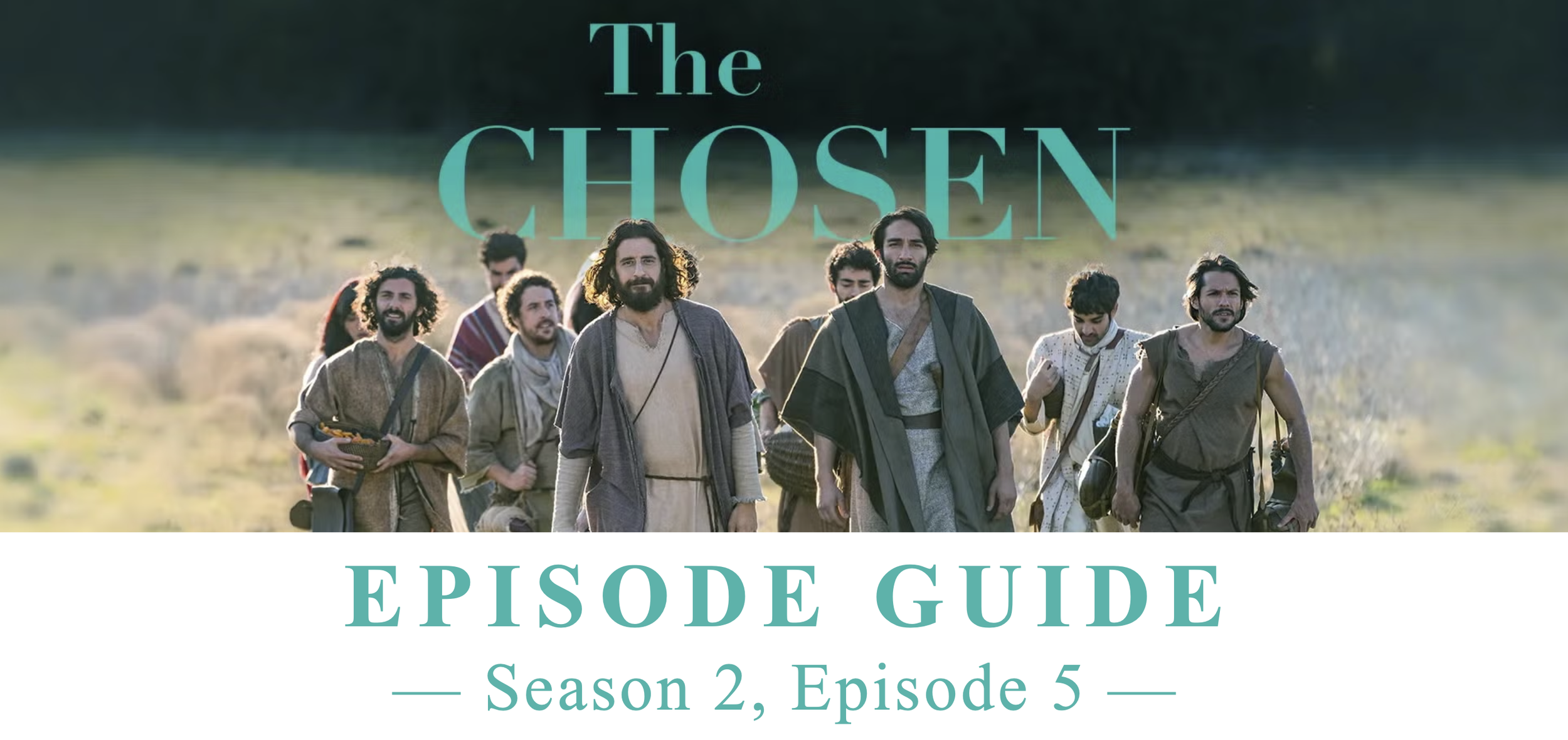
The Chosen Episode Guide: Season 2, Episode 5
This is an episode that is deeply speculative…though this is true, there are some helpful things along the way as well.
S2, E5
This is an episode that is deeply speculative. Additionally John the Baptists character seems to be a bit silly. I’m guessing the people represented in the pages of the Bible knew how to have fun, but it seems to me that John is presented in much more reverent terms than seen here. Though these things are true, there are some helpful things along the way as well.
Biblical: What We Find in Scripture
Immediately after the title sequence, the man who had been healed at the pool of Bethesda is being questioned by the Pharisees. While there are many details added in the chosen, this happened and can be read about in John 5:10ff.
Unbiblical: What Contradicts Scripture
None
Extra-biblical: What Is Made Up but Doesn’t Contradict Scripture
In the opening scene, where Mary Magdalene is picking persimmons, Mary sees some Roman soldiers. She hides from them, apparently in fear. This scene is not found in the pages of Scripture, and I am curious as to where the writers are going with it. Certainly the Jewish people did not like the occupation of Israel by the Romans, but there isn’t anything in the Bible that would suggest people were struck with terror at the sight of a Roman soldier.
As previously mentioned, Atticus is a made-up character for the chosen. His interaction with “Jesse”, the man healed at the pool of Bethesda, is fictional. “Jesse” is here put in quotation marks because we are not told the name of the man in John 5, the only portion of the gospels that records his healing.
The fireside scene of “Simon Z”, called in Scripture Simon the Zealot to distinguish him from Simon Peter, and his interaction with the demon-possessed man is not in the biblical record. Interestingly, Simon Z uses the phrase “waterless places” to speak of where the demon would go if the possessed man were to die. The phrase “waterless places” is used by Jesus in Matthew 12:43 and Luke 11:24. In the Bible, Jesus is the only one to use this term.
Jesus’ interaction with John the Baptist is not found in the Bible; however, it is based upon some things that are recorded in Scripture. Herodias was the wife of Philip, the brother of Herod Antipas (Mt. 14:3). Philip had indeed married Herodias (Mt. 14:3; Mk. 6:17). And John the Baptist had spoken out publicly against this (Mt. 14:4; Mk. 6:17). The continuing conversation with Jesus and John isn’t in the Bible either. However, I find this conversation odd. Jesus never seemed to have any problem confronting sin, but here is represented that way. Certainly, Jesus didn’t pick every fight he could have, but this seems a little out of character. John’s statement that he was miraculously conceived by two old people to pave the way for Jesus is also a true statement (Lk. 1).
Ramah is a fictional character. Obviously, the scene where Mary Magdalene is teaching her to read isn’t from the Bible. Although Mary’s statement that some letters in Hebrew are “swallowed up” by others is accurate. This part of learning Hebrew is very difficult. Matthew and Thomas’s interaction during this scene is also fictional.
This episode harkens back to previous episodes where Jesus casts demons out from Mary Magdalene. Luke 8:2 records that 7 demons were cast out from Mary Magdalene, but when the demon-possessed man shows up in the camp and calls Mary Lilith, this is drawing on things outside of Scripture. Mary is never called Lilith in the Bible. Scripture records that Jesus could cast out demons that Jesus could not, but it never records these events with a demon-possessed man named Caleb.
There is also no biblical record of how Simon the Zealot became a disciple. His name occurs in the lists of the disciples of Jesus in Matthew 10, Mark 3, and Luke 6. Several of the scenes include parts of Simon the Zealot’s calling. All of the scenes whereby “Simon Z” is called to be a disciple are speculation.
While the Pharisees questioned Jesus and the man healed at the pool of Bethesda, there is nothing in the Bible that records any filing of formal complaints. This scene with Shmuel trying to follow up on formal charges was written solely for the Chosen.
Jethro is not a biblical character in the Gospels. All the interactions of Mary and Jethro are not taken from the biblical record but rather written for the show.
The closing scenes of the show where Jesus is practicing a sermon, the disciples and others are gathered around a fire in camp, the Pharisees are plotting to try and figure out who Jesus is, Mary’s escape to go see someone named Jethro, and Peter and Matthew’s departure to find Mary are all fictitious.
Helpful: What We Might Be Helpful To the Watcher
In the scene where the demon-possessed man wanders into the camp of the disciples, Jesus arrives and immediately casts out the demons from the man. While this story is fictional, it shows the power of Jesus over demons. We should expect that Jesus had this kind of power over demons.
In Jesus’ calling of Simon the Zealot, he throws Simon’s dagger into the lake. This scene is fictional and doesn’t line up with some of the events we see in the Bible as there are times when the disciples have swords. However, there is something helpful here. Jesus called the disciples to leave whatever lives they were living to follow him. Mary did follow Jesus. Peter, as well as others, gave up fishing. Matthew left the tax booth. We should expect that Simon was expected to give up his life of political aspirations as a Zealot. Jesus had much bigger plans for “Simon Z” than the political aspirations he had previously.
Dangerous: Things That Have Been Added That Might Be Dangerous to Accept as Fact
I believe that there is a danger inherent in every episode, and for that reason, I’m including this suggestion in every episode guide. The danger is assuming that the things in the episodes of the Chosen that are not in the Bible are true, part of the biblical record. In order to avoid this danger, I would encourage everyone who watches the Chosen to compare it to the biblical record. IN part, this is because most of what is in each episode of the Chosen is not found in the Bible. There is more speculation here than actual events recorded in the Bible. If you want a harmony of all of the gospels in chronological order to aid this, then I would recommend purchasing a copy of One Perfect Life by John MacArthur. It is a compilation of all of the gospel records in order of the events as best as we can understand.
Anachronisms and Errors: Things that are out of place regarding the time, etc.
There are a few, but they are inconsequential.
The Chosen Episode Guide: Season 2, Episode 4
One of the things that The Chosen is prone to do is create drama or a cliffhanger using events that aren’t in the Bible. This episode is an example of this. My concern is that they are using fiction to create an emotional response instead of true things.

S2, E4
One of the things that The Chosen is prone to do is create drama or a cliffhanger using events that aren’t in the Bible. This episode is an example of this. My concern is that they are using fiction to create an emotional response instead of true things.
Biblical: What We Find in Scripture
While we don’t know his background, we do know that there was a mean, healed by Jesus, who tried to enter the waters of the pool of Bethesda in order to be healed. People would try to enter the waters while they were being stirred up in order to receive healing. This is recorded in John 5:2-15. There are multiple scenes where we are presented with the backstory of this man, all of which is fictional.
Simon Z, though not referred to in this way in the Bible, is the disciple often called Simon the Zealot. This distinguished him from Simon Peter since there were two disciples named Simon. While we don’t know much about Simon, the Zealots were a Jewish resistance group that sought to overthrow Rome, including using violent means. While we don’t really know his backstory, this is a helpful depiction. Much of it is therefore fictional, but Simon Z was in fact Simon the Zealot.
The feast of tabernacles was celebrated annually by the Jews. It is sometimes called the feast of booths. This feast commemorated the leaving of Egypt when the people had to dwell in booths, or tents, in the wilderness. Each year families would build booths and live in them for the duration of the festival.
When Jesus healed the man at the pool of Bethesda, the man was told to pick up his mat, and the Jews did correct him for this. Jesus had withdrawn and the man didn’t know who he was. This is all recorded in the previously mentioned verses in John 5. Later Jesus found the man in the temple and told him not to sin anymore. We are also told that Jesus was persecuted because of this.
Unbiblical: What Contradicts Scripture
None
Extra-biblical: What Is Made Up but Doesn’t Contradict Scripture
The opening scene where a boy falls out of a tree and breaks his leg is fictional. This is later revealed to be the man at the pool of Bethesda. We don’t really know much background, or for that matter any, for those in the gospels who Jesus healed.
There is no biblical record of the activity of the Zealots. In fact, the only use of the word is the four times it is used in the gospels and Acts to refer to Simon. Whatever activity, training, leaders, etc. of the Zealots that are depicted in this episode is fictional.
Zebulun is one of the tribes of Israel, and thus is a territory in Israel. There is no biblical record of a Zealot coming from there. Its name occurs only in 3 places in the New Testament. Twice in Matthew 4 when Jesus goes there and fulfills a prophecy about Zebulun. And once in Revelation 7 where the 12 tribes of Israel are named.
No Roman soldier is named in the gospels.
The scene where the disciples and Jesus are celebrating the festival of booths is fictional.
The scene with Matthew, Peter, and one of the other disciples into Jerusalem isn’t recorded in the Bible.
The conversation with “Jesse,” the man at the pool of Bethesda, and Jesus is greatly elaborated on. While this healing happened, and while there are elements of this story that are true, there is much that has been added. Additionally, Jesse’s searching for his brother and the plot to assassinate a Roman official are not recorded in Scripture.
The disciples never asked Jesus why he healed the man on the Sabbath, and Jesus never replied that sometimes you must stir up the water.
Helpful: What We Might Be Helpful To the Watcher
While the opening scene with the boy who broke his leg may not be recorded in the pages of the Bible, there is some helpful info here. It is easy, in light of modern medicine, to think that people could have just splinted a broken bone and it would heal, and there may be some truth to this. However, this would depend upon the severity of the break. A bad break would be very unlikely to have been healed in a way that would have allowed the individual to fully regain use of that limb. Additionally, since there isn’t much background info given in the Bible regarding those who Jesus healed, this type of background, though fictional, serves to remind us that the people Jesus healed were real people, with real stories, and real anguish.
Dangerous: Things That Have Been Added That Might Be Dangerous to Accept as Fact
I believe that there is a danger inherent in every episode and for that reason I’m including this suggestion in every episode guide. The danger is assuming that the things in the episodes of the Chosen that are not in the Bible are true, part of the biblical record. In order to avoid this danger, I would encourage everyone who watches the Chosen to compare it to the biblical record. IN part, this is because most of what is in each episode of the Chosen is not found in the Bible. There is more speculation here than actual events recorded in the Bible. If you want a harmony of all of the gospels in chronological order to aid this, then I would recommend purchasing a copy of One Perfect Life by John MacArthur. It is a compilation of all of the gospel records in order of the events as best as we can understand.
Anachronisms and Errors: Things that are out of place regarding the time, etc.
Wax candles are still not something that would have been often used. Small oil lamps were used to provide light.
The depiction of crucifixion isn’t accurate. In this depiction, the man on the cross is standing on a platform. Sometimes platforms were used to prolong agony, but the weight of the individual would have been primarily hanging on the victims arms. This would cause the victim’s lungs to fill with fluid and they would suffocate.
The man at the pool told his brother that the upper city was less than a mile away. The whole city would not likely have been a mile wide. The images around Jerusalem, as well as this statement, present the area of Jerusalem as much larger than it actually was at that time.
The Chosen Episode Guide: Season 2, Episode 3
Though God of all creation, he lived by the rules of the weakness of humanity for 33 years. The almighty God was humble…

S2, E3
The title of this episode is “Matthew 4:24.” There are three passages in the gospels that refer to the events around this verse…Matthew 4:23-25, Mark 1:35-39, and Luke 4:42-44. All three of these passages, as you can see, are very short, and all three simply summarize that Jesus was going through Galilee, teaching in the synagogues and healing people of various kinds of diseases, and that his fame spread throughout the region as a result. It is therefore likely that almost all of this episode will be speculative, leaving it squarely in the “extra-biblical” category.
Biblical: What We Find in Scripture
Jesus did go about healing people in Galilee, as recorded in the passage listed above. This seems to be the only thing that we know to be factually true in this episode.
Unbiblical: What Contradicts Scripture
Other than at the wedding in Cana of Galilee, and until the cross, when Mary the mother of Jesus appears in the gospels, she is usually with her other children. Here in this episode, as with others, Mary is often seen traveling within Jesus, the disciples, and others. This doesn’t seem to align with what we most often see in the gospels. Cf. Matthew chapters 10 and 12.
I don’t know where to put this comment, so I am going to put it here, but I have imagined the role the disciples played to be very different than what is depicted in this episode. In the episode, Jesus is healing while all of his followers are sitting around a fire talking. I imagine that the disciples would have been with Jesus, seeing the things that he was doing, managing the crowds, etc. I find it unlikely that Jesus was off working while the disciples were off reclining around a campfire.
Extra-biblical: What Is Made Up but Doesn’t Contradict Scripture
In the opening scene, Matthew is talking to Philip about the Psalms while people are lined up to receive healing by Jesus. There are a few things that should be mentioned here. First, there is no indication in the gospels that Matthew was ignorant of the Scriptures; we just know that he was a tax collector before he followed Jesus. Second, in the passages mentioned above, we are not given any details about how many people came to be healed by Jesus. However, I think this opening scene underestimates how many people were being brought to Jesus. Mt. 4:24 indicates that his fame spread through “all Syria” and that they brought him “all the sick.” This scene hints at what was going on in these passages, but probably on a scale that was too small. Additionally, the conversation of the disciples around the fire while Jesus healed people is not recorded in Scripture. This conversation is made up and, therefore, extrabiblical.
Helpful: What We Might Be Helpful To the Watcher
The conversation around the fire might be helpful, even in a fictional context. We often see that Jesus was very different than the expectations that the people had for him, even amongst the disciples. As the disciples try to figure out what Jesus is doing in this scene, it no doubt helps us to see a bit of how they may have been confused by the way that Jesus went about his work.
Often we see that when the crowds gathered around Jesus, he had to take time to get away to pray and rest. While this episode seems to be entirely fictional, the fact that Jesus is continuing healing into the night helps the watcher to see just how hard Jesus worked.
When Peter is expressing his anger to Matthew, there is something helpful here. First, there is good insight into why the Jews hated tax collectors. They were seen as sellouts to Rome. However, once again, this scene assumes that Matthew didn’t know what it meant to be a Jew.
When Jesus comes back to camp from healing the sick, Mary washes his feet. As Jesus goes to bed, he says that he is tired. God got tired. How unusual that 33 years of his time on Earth it must have been for Jesus. Though God of all creation, he lived by the rules of the weakness of humanity for 33 years. The almighty God was humble…
Dangerous: Things That Have Been Added That Might Be Dangerous to Accept as Fact
I believe that there is a danger inherent in every episode, and for that reason, I’m including this suggestion in every episode guide. The danger is assuming that the things in the episodes of the Chosen that are not in the Bible are true, part of the biblical record. In order to avoid this danger, I would encourage everyone who watches the Chosen to compare it to the biblical record. IN part, this is because most of what is in each episode of the Chosen is not found in the Bible. There is more speculation here than actual events recorded in the Bible. If you want a harmony of all of the gospels in chronological order to aid this, then I would recommend purchasing a copy of One Perfect Life by John MacArthur. It is a compilation of all of the gospel records in order of the events as best as we can understand.
As the conversations around the fires continue, a couple of the disciples have a conversation about why Jesus hasn’t healed one of them all while he is healing so many other people. This introduces a problem that is going to rear its head again in season 4. There is no evidence in the gospels that Jesus ever refused healing to anyone. There is no indication that any of the disciples need healing. And while the conversation admits that this disciple had never asked Jesus for healing, it must be noted that Jesus healed everyone who asked him to heal them, and even some who didn’t.
Anachronisms and Errors: Things that are out of place regarding the time, etc.
While the disciples are around the fire talking about ways that they had broken the Jewish dietary laws, one of the disciples says that he had tried pork and it was marvelous. This is unlikely. Having been there, I can testify that the Jews find pork disgusting.
The Chosen Episode Guide: Season 2, Episode 2
Most of this episode is either fiction, or even in this case error. However, the episode lands on a pretty good note with a fairly biblical presentation of the calling of Philip and Nathaniel.

S2, E2
Most of this episode is either fiction, or even in this case error. However, the episode lands on a pretty good note with a fairly biblical presentation of the calling of Philip and Nathaniel.
Biblical: What We Find in Scripture
After Jesus calls Philip in Jn. 1, Philip goes and finds Nathaniel. While almost everything in this episode is either fictional or erroneous, at least this detail is correct (Jn. 1:45).
I’m not willing to relate it to any one specific account, but Jesus is recorded by the gospel writers as telling the disciples 3 times that he would be departing from them, and each time they did not understand. Each of these 3 predictions of his death occurred while Jesus and the disciples were on the road. However, it seems as though each of these predictions was to all of the disciples, not just Peter.
Philip’s seeking of Nathaniel, Nathaniel’s initial rejection of Jesus as the Messiah, Philip’s invitation to Nathaniel to “come and see”, Jesus’ calling Nathaniel and Israelite in whom there is no deceit, Jesus saying he saw Nathaniel under the fig tree, Nathaniel’s confession of who Jesus is, and Jesus statement that Nathaniel will see greater things than this are all recorded in Jn. 1:45-51. There are certainly some embellishments there in order to round out the scene. But this scene where Philip seeks Jesus is quite correct.
Unbiblical: What Contradicts Scripture
The scene where Philip comes into the field with 4 of the disciples is not recorded in the Bible. Philip’s calling is recorded in Jn. 1:43-44. There is an anachronism in the scene as well as a contradiction to John’s record of his calling. First, the anachronism, or something that is not correct to the time. These events are supposed to happen early on in Jesus’ ministry. Jesus’ early ministry was marked by wide acceptance, even enthusiasm, of Jesus’ ministry. The disciples would not likely have been so hesitant at that point, especially of one individual who wouldn’t have been part of a band of raiders. The error comes in the fact that Philip was looking for Jesus. Jn. 1:43 reveals Philip and Nathaniel were called when Jesus, upon entering into Galilee, found Philip. When Jesus comes into the camp later, Philip introduces himself. Again, John records that Jesus found Philip, not the other way around. Nathaniel’s calling comes right after Philip’s.
Extra-biblical: What Is Made Up but Doesn’t Contradict Scripture
It is unclear who is in the opening scene, and I am unclear on how this is going to connect to any story, but it at least appears to be something fictional.
Philip’s meeting of Matthew, and their subsequent conversation on the road, is not found in the Bible.
Matthew’s continued social awkwardness, even disability, isn’t found in the pages of the Bible. There isn’t any indication in the Bible that Matthew struggled in this way.
The architect from the opening scene is later, who also has the drink in the bar, is later revealed to be Nathaniel. Jn. 1:45ff (ff means “following”) records Nathaniel under the tree burning a set of plans and asking of God, “do you see me?” This is probably setting the stage, as recorded in John 1, for Nathaniel’s calling. When Jesus called Nathaniel, he is questioned by Nathaniel as to how the Messiah could possibly come from Nazareth. It is at this point that Jesus tells Nathaniel that he saw him under the fig tree (Jn. 1:48).
Nicodemus continues to be a character that, while biblical, has a lot of fictional things about him inserted. This is the case in this episode. Additionally, at the risk of sounding like a broken record, Ramah is not a character in the Bible. Any part she plays in any episode is not found in the Bible.
Philip’s story of John’s disciples not knowing each other’s names is not in the Bible.
We have no record that Simon Peter objected to any of the disciples writing things down.
Helpful: What We Might Be Helpful To the Watcher
While we have no record in the Bible of the disciples using push carts to move their stuff, the scene on the road is helpful. The disciples must have had some way to move their belongings. If we learn something from Jesus washing the disciples’ feet, it is not unlikely that there may have been other times that the disciples didn’t want to let Jesus do menial tasks as their rabbi, and it wouldn’t have been unlikely that Jesus insisted on doing them. At the end of this episode, that scene is still fictional.
Dangerous: Things That Have Been Added That Might Be Dangerous to Accept as Fact
I believe that there is a danger inherent in every episode, and for that reason, I’m including this suggestion in every episode guide. The danger is assuming that the things in the episodes of the Chosen that are not in the Bible are true, part of the biblical record. In order to avoid this danger, I would encourage everyone who watches the Chosen to compare it to the biblical record. IN part, this is because most of what is in each episode of the Chosen is not found in the Bible. There is more speculation here than actual events recorded in the Bible. If you want a harmony of all of the gospels in chronological order to aid this, then I would recommend purchasing a copy of One Perfect Life by John MacArthur. It is a compilation of all of the gospel records in order of the events as best as we can understand.
Anachronisms and Errors: Things that are out of place regarding the time, etc.
Again, Matthew is said to have a dog, this time saying himself as he recounts what he had before following Jesus. Dogs were not kept as pets in Israel. They were considered ritually unclean animals.
The Chosen Episode Guide: Season 2, Episode 1
The Bible contains everything that is needed to move our hearts. I would rather the writers and editors use those things that are inspired by the Spirit to inspire the watcher.

S2, E1
Here we start season 2 with Episode 1. If you are new to these, I have completed episode guides for every episode in season 1 and 5. Here we begin to continue to work our way through all of the episodes of The Chosen to see what is in the Bible and what is not, what is helpful and what might be harmful.
Biblical: What We Find in Scripture
Nothing. Certainly Jesus did travel to Samaria and meet a woman at the well in Sychar. However, the things that are actually recorded in the Bible all happened in the previous episode, episode 8 of season 1.
Unbiblical: What Contradicts Scripture
The teaching of the lost sheep is recorded in Matthew 18 and in Luke 15. The former seems to be set in Capernaum, the latter in Jerusalem. This means that Jesus probably taught that parable more than once, which would be expected. However, there is no biblical record to state that Jesus taught that in Samaria. Mt. 18 and Lk. 15 also both happen later in Jesus’ ministry than his visit to Samaria. While it’s possible that this teaching happened in Samaria, a possibility not recorded in Scripture, it is recorded that Jesus taught that Parable in Galilee and Jerusalem. I am therefore including this portion of this episode in the unbiblical category.
In the scene where the disciples are going out to buy food to prepare, a fictional scene, Matthew is seen distributing the gold coins from the fictional bag of coins that was found in the previous season. Judas is the disciple who is recorded in Scripture as keeping the purse (Jn. 12:6).
I almost put this point in the “Biblical” category out of sympathy because so far this entire episode has either been fictional or confusing. Ultimately I decided to put it here because so many of the details are confused. James and John were given the name “sons of thunder” by Jesus because they wanted to see fire called down from heaven. However, as this is recorded in Luke 9:51, I think once again the timeline is off. This episode is presented to us as very early on in Jesus’ ministry, and in fact it should be as Jesus encountered the woman at the well very early on in his ministry. However, it is much later in his ministry that James and John receive the title that they are given. This might be forgivable as the timeline in the NT is often hard to understand. However, here is why I think this scene is contradictory. In Lk. 9 when the two brothers want to call down fire from heaven, it is because a whole village rejects Jesus. Here in this episode it is merely 3 travelers.
Extra-biblical: What Is Made Up but Doesn’t Contradict Scripture
This episode begins with the disciples, looking markedly older than in the previous episodes, giving what appears to be interviews to someone. All of this is fictional, though there are some elements drawn from true things. Andrew speaks of his calling while he was with John the Baptist. Andrew was in fact a disciple of John the Baptist before he was a disciple of Jesus (Jn. 1:35-40). There is no knowledge of where Jesus met Mary Magdalene the first time, we just know that Jesus cast demons out of her (Mk. 16:9, Lk. 8:2).
We are shown that the person interviewing people was the disciple John. John certainly was an eyewitness to the events and certainly recorded them as an eyewitness. While we don’t know exactly who wrote the first gospel, it is largely believed that the gospel of Mark was written before the other gospels, and there seems to be reasonable evidence for this. In the interview with his mother, John’s mom states that the whole world could not contain the books that would be written if everything were to be recorded. John’s gospel says this in Jn. 21:25, though we have no knowledge that this saying came from his mother or anyone else. Those are presented to us in the Bible as the words of John.
Ramah and her family are entirely absent from Scripture. While scenes involving her in the future may be drawn from biblical accounts, Ramah and her family are, and will always be, entirely made up.
The only thing that is known about Jesus’ time in Samaria after meeting the woman at the well is that he stayed there a couple of days (Jn. 4:40).
Matthew is often portrayed as odd, even maybe at times appearing to have some kind of sensory disorder. This isn’t informed by Scripture. The socially odd nature of Matthew is something that is made up by the Chosen’s writers.
The scene where the disciples are going through the streets of Samaria to buy food isn’t in the Bible. In fact, maybe we could just put here that all of the scenes that take place in Samaria are fictional because there is no record of Jesus’ time in Samaria other than his interaction with the woman at the well and the statement that he spent two more days there.
To be specific, even though you could probably discern this already, the healing of the man in Samaria is fictitious.
Helpful: What We Might Be Helpful To the Watcher
While the scene with James and John preparing a field for seed is not in the Bible, it is helpful in showing just how difficult farming would have been. Farming would have largely been done using animals and not human labor for the plowing, but it was still hard work.
The scene with Big James and John where the Samaritans throw rocks at them and Jesus is not from the Bible. But the truth of the matter is that none of us are worthy. That is certainly a helpful lesson for us all to learn.
The Samaritans used what is called the “Samaritan Pentateuch.” The Pentateuch is the 5 Books of Moses that open the Old Testament. They did not have, or more likely did not think they needed, the other 34 books of the Old Testament that Jews had.
The Jews did also use the word “logos”, which gets translated as “word” in our Bible’s to describe, as it is called in this episode, “divine reason.” Reason being a cause, not a thought. The Greeks talked about the logos as the things which caused, or created, all other things. This is why John opens his gospel the way that he does, as shown in this episode. This is not a historical fact recorded in Scripture. However, it does seem that John opens with the words “In the beginning” to draw us back to Genesis 1, and he uses the word logos for Jesus in his opening chapter to present Jesus to us as the “Divine Reason”, the cause of all creation.
Dangerous: Things That Have Been Added That Might Be Dangerous to Accept as Fact
I believe that there is a danger inherent in every episode, and for that reason, I’m including this suggestion in every episode guide. The danger is assuming that the things in the episodes of the Chosen that are not in the Bible are true, part of the biblical record. In order to avoid this danger, I would encourage everyone who watches the Chosen to compare it to the biblical record. IN part, this is because most of what is in each episode of the Chosen is not found in the Bible. There is more speculation here than actual events recorded in the Bible. If you want a harmony of all of the gospels in chronological order to aid this, then I would recommend purchasing a copy of One Perfect Life by John MacArthur. It is a compilation of all of the gospel records in order of the events as best as we can understand.
Related to this episode, I have a concern about the scene in Samaria with the man whose field Jesus planted. There is a trend in some of the episodes that I have seen to make the most dramatic, most noteworthy, most emotional scenes from things that there is no biblical record of. It seems like emotional and/or spiritual manipulation to make the things that tug at our heartstrings the most be those things that never happened. The Bible contains everything that is needed to move our hearts. I would rather the writers and editors use those things that are inspired by the Spirit to inspire the watcher.
Anachronisms and Errors: Things that are out of place regarding the time, etc.
Once again, I will admit that I am being a little picky on this point, but the geography of Jerusalem and Samaria isn’t correct. While there are snow-peaked mountains in the northern part of Israel, Jerusalem is the highest peak around in its area and doesn’t get snow.
Colorful cloth, especially long cloths, would have been very expensive. It is incredibly unlikely that any sort of colorful cloth would have been used to drape over streets or over vendors’ booths.
The glass in the house of the woman that Jesus met at the well is more like glass might have been. Small pieces and opaque, not clear. However, this would likely have been something that was only in the house of the wealthy.
Wax candles seem out of place as well. Most likely, there would have been small lamps that burned olive oil.