

BLOG

The Chosen Episode Guide: Season 1, Episode 8
It has been a few weeks since I have posted an episode guide, but here we find ourselves back into Season 1 after having tackled Season 5. I will continue to work my way through each of the seasons week by week.
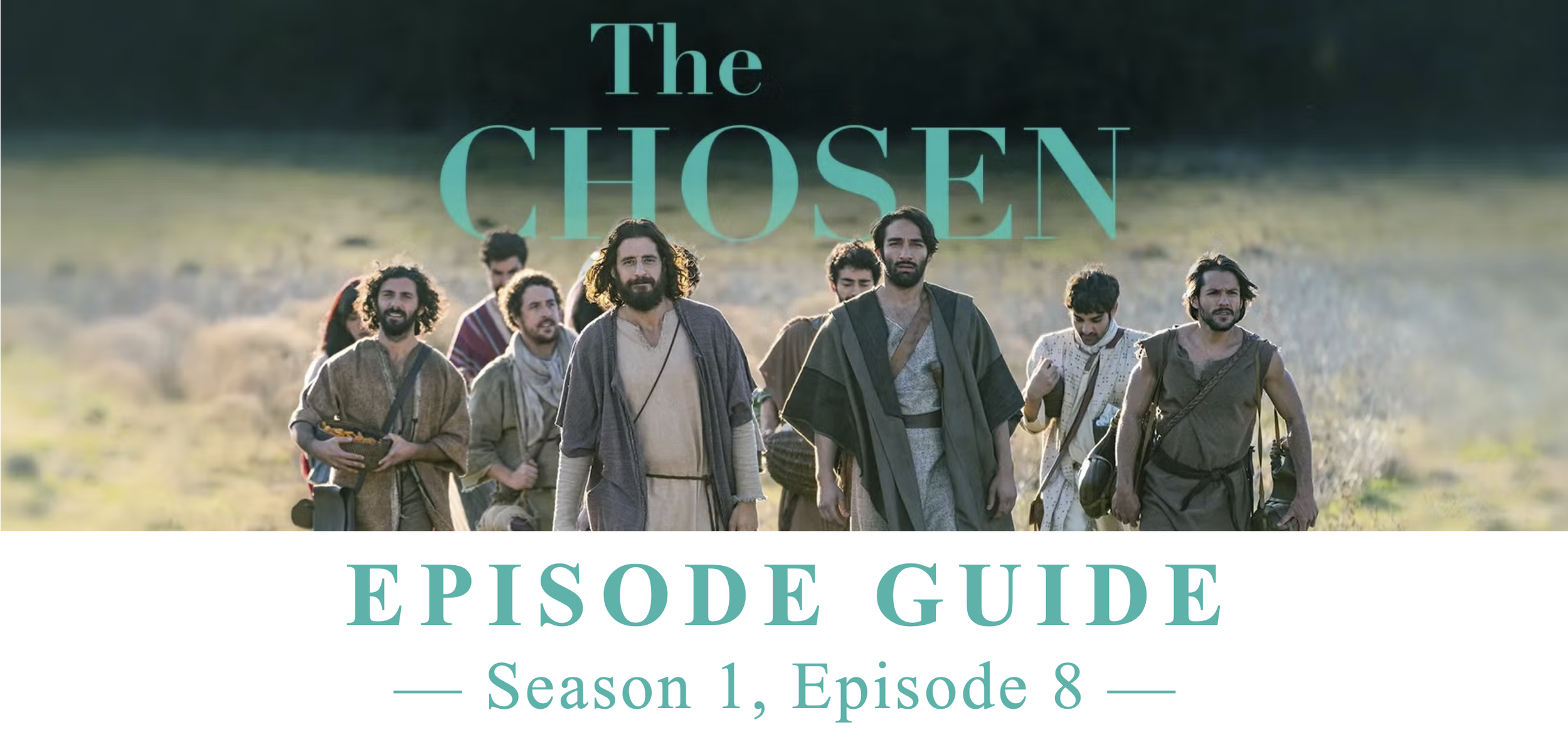
S1, E8
It has been a few weeks since I have posted an episode guide, but here we find ourselves back into Season 1 after having tackled Season 5. I will continue to work my way through each of the seasons week by week.
Biblical: What We Find in Scripture
While much of the detail is added, the disciple Matthew, who was also a tax collector, had a dinner in his home for Jesus (Mt. 9:9-13; Mk. 2:13-17; Lk. 5:27-32). Matthew is called Levi in the texts in Mk and Lk, Matthew’s original name. While we don’t know how or why some of the Pharisees saw this, and while we don’t know the names of any of the Pharisees who did, we know that they were disturbed that Jesus would be willing to eat with social outcasts like tax collectors. When questioned about his reason for eating with them, Jesus replied that it is the sick and not the well who are in need of a physician.
Some of the events around the healing of Simon’s mother-in-law are certainly fictional, particularly the parts about Jesus healing her to relieve the burden of Peter’s wife and to keep Peter from being anxious while traveling with Jesus. However, the actual healing is pretty close to correct. Mt. 8, Mk. 1, and Lk. 4 all record the event. As we consider them all, we see that Jesus entered Peter’s house, took the hand of Peter’s mother-in-law, rebuked the fever, and that she got up and began to serve them.
There is a lot of liberty taken in the dialogue with the Samaritan woman at the well, but much of the biblical dialogue from John 4 is there as well. Jesus asks her for water, she is surprised that a Jew would ask her for water, and Jesus offers her living water. She perceived him to be a prophet, but he told her that he was the Messiah. She does go into the city and tell people about Jesus. In the biblical record, Jesus does not recount each of the husbands of the Samaritan woman, nor does he claim to know Jacob, who dug the well. The woman does ask Jesus about what mountain people are to worship on. This is because the Jews worshipped and sacrificed on Mt. Moriah, where the temple was and where the Dome of the Rock is today. The Samaritans had their own version of the Scriptures and offered their own sacrifices on Mt. Gerizim. In essence, she was asking who was right. Jesus was indicating that Father wasn’t seeking worshippers who worship on one mountain or another, but who understand him to be the Messiah and worship God in Spirit and in Truth.
After the Samaritan woman went into town to tell people who she had met, the disciples arrived marveling at who Jesus was willing to have a conversation with. They encouraged Jesus to eat, to which Jesus responded by saying that he had food to eat that they didn’t know about. Of course, he was talking about doing the work that the Father had for him to do. Jesus and the disciples also stayed there for a couple of days and ministered in that region.
Unbiblical: What Contradicts Scripture
Nothing
Extra-biblical: What Is Made Up but Doesn’t Contradict Scripture
This episode, like others, opens with a flashback to Old Testament events. Clearly, this opening scene is a set-up for the conversation of the Samaritan woman at the well of Jacob. However, this cannot be biblical as there is no information about Jacob’s well given in the Old Testament. It is mentioned in the New Testament, and Genesis 33 says that Jacob lived near a well. However, the only reference to Jacob’s well in the New Testament is found in John 4, where Jesus meets with a Samaritan woman at what is traditionally thought to be Jacob’s well. In truth, almost nothing is known about this well and its location.
There are no biblical characters named Neriah nor Photina. These characters in the scene following the title sequence are fictitious.
As previously mentioned, almost nothing is said of Nicodemus in the New Testament. His role in this episode, which occurs in several scenes, continues to be entirely fictional.
Quintas and Gaius are still fictional characters and therefore their role in any episode is not from the Bible.
While Peter is recorded as having a wife in the New Testament, no conversation is recorded in Scripture where the disciples and Jesus discuss this and its effects on the disciples who are married vs. single.
I don’t know who the characters are supposed to be in the scene where a woman purchases an orange in the marketplace, but this is not in the biblical record. This woman is later revealed as the Samaritan woman at the well.
At no point in the Bible are we told that there was a decree written from any Roman ruler forbidding worship gatherings outside of a temple, synagogue, or Hebrew school. The Roman soldier issuing the decree, whether Quintas or Gaius ( I don’t know; I believe it to be the latter), are fictional characters. We also don’t know of any Roman leader seeking the questioning of Jesus in the Bible until the Sanhedrin delivered Jesus to Pontius Pilate. We do know that Herod Antipas wanted to meet Jesus because he thought he was some type of incarnation of John the Baptist, whom he had beheaded earlier.
There is no record in the Bible of Nicodemus leaving money for Jesus, nor of Jesus encouraging Nicodemus to join them while Nicodemus is waiting in the shadows.
The meeting of the Roman soldier Quintas (I think that is his name in this episode) with Matthew’s parents is not recorded in the Bible.
Helpful: What We Might Be Helpful To the Watcher
While we don’t know how Matthew left his job as a tax collector, he certainly did leave that role to follow Jesus. The Roman tax system was called the publicany (called a publicanus in this episode). Publicans, or tax collectors, would buy tax districts. They were to give Rome what was due them, and they were able to keep whatever they could extort from the people in their district. It is possible, maybe even probably based upon the biblical accounts, that Matthew just walked away. If he did, the district would have been sold to someone else.
While Jesus doesn’t use the phrase as “I am God” as we would understand it in English, he nonetheless claimed divinity in a way that the people of the day would have understood it. Nicodemus’s conversation with one of the rabbis about Jesus’s claim to be God is helpful in seeing that the people in his day clearly understood him to be making that claim. An unhelpful part of this dialogue is when the rabbi that speaks to Nicodemus calls the law God. That seems to be a judgment on the part of the authors of this episode about the Jews in that day. However, the rabbis would not have claimed that the law was God even though they took obedience to the law very seriously as an act of worshipping and obeying God.
The disgust of the Jews for the Samaritans is captured well in the scene where Jesus suggests to the disciples that they will be traveling through Samaria. While there are some historical reasons that are given in this episode, the biblical reason is not. The Samaritans were the offspring of the Jews who were left behind in the Babylonian captivity and married foreign wives. They were considered to be something of a half-breed, if you might pardon the term. They were hated by the Jews for that reason.
Dangerous: Things That Have Been Added That Might Be Dangerous to Accept as Fact
I believe that there is a danger inherent in every episode, and for that reason, I will begin to state what is in each episode guide. The danger is assuming that the things in the episodes of the Chosen that are not in the Bible are true, part of the biblical record. In order to avoid this danger, I would encourage everyone who watches the Chosen to compare it to the biblical record. IN part, this is because most of what is in each episode of the Chosen is not found in the Bible. There is more speculation here than actual events recorded in the Bible. If you want a harmony of all of the gospels in chronological order to aid this, then I would recommend purchasing a copy of One Perfect Life by John MacArthur. It is a compilation of all of the gospel records in order of the events as best as we can understand.
Anachronisms and Errors: Things that are out of place regarding the time, etc.
The order that was decreed about not having worship gatherings outside of certain places was said to be posted in Aramaic, Latin, and Greek. The order that God posted was only in Aramaic.
While the events of Matthew’s parents being given to his house are fictional, there is something erroneous about Matthew’s parents meeting his dog. Dogs were not considered to be household pets like they are today; they would have been thought of as disgusting creatures, even if not unclean.
The Chosen Episode Guide: Season 1, Episode 7
I was hopeful after season 1, episode 6 that we would see more of the content being drawn out of scripture and less from speculation. This isn’t the case in this episode, but that doesn’t mean that there aren’t helpful things here.

S1, E7
I was hopeful after season 1, episode 6 that we would see more of the content being drawn out of scripture and less from speculation. This isn’t the case in this episode, but that doesn’t mean that there aren’t helpful things here. There are some things in this episode that can help us understand the background of the times of Jesus and the disciples.
Biblical- What We Find in Scripture
In John 3, Nicodemus confesses that no one can do the miracles that Jesus unless he is sent by God. They spoke of the need to be born again by the Spirit, and Nicodemus did not understand what Jesus was talking about. They also spoke of how Nicodemus didn’t understand. However, much of the conversation between Nicodemus and Jesus is fictional. Rather than trying to go line by line and point out what is in Scripture and what isn’t, I would strongly encourage you to go read John 3:1-21.
Matthew 9:9-13 records that Jesus called Matthew while he was in the tax booth. The interaction with Gaius is fictional, but when Jesus called Matthew from his tax booth, Matthew left to follow Jesus.
Unbiblical- What Contradicts Scripture
Nothing
Extra-biblical: What Is Made Up but Doesn’t Contradict Scripture
While I feel like a broken record, the Roman soldiers who are working with and protecting Matthew are fictional characters. Therefore, any interaction they have with any Roman leaders in this episode is fictional.
Nicodemus plays such a small role in Scripture that it is surprising that he takes such a prominent role in The Chosen. In John 3, Nicodemus comes to Jesus to ask him about the kingdom by night. Nicodemus appears in the gospel 2 more times. Once in John 7, where the people are divided about who Jesus is, and Nicodemus warns the people not to judge a man without a hearing. And once in John 19, where he is bringing spices to the body of Jesus for burial, indicating that Nicodemus most likely had become a follower of Jesus. Any other scenes with Nicodemus in them, either in this episode or any other, are entirely fictional.
Jesus’ conversation with Thaddeus, John, and Mary Magdalene that occurred while packing up camp is fictional.
All of the preparations of Jesus and the disciples for Jesus to meet with Nicodemus are fictional. John 3 records that Nicodemus came to Jesus by night, but no other details are recorded except for some of their conversation. The fact that Nicodemus came by night is likely indicative of a secret meeting. Nicodemus probably came to meet with Jesus by night, most likely in secrecy.
Jesus and Nicodemus speak of the healing of the paralytic being lowered through the roof. It is conjecture that Nicodemus was present for this miracle. Clearly from John 3, Nicodemus had seen Jesus perform miracles, but we do not know what miracles he saw. There is a lot of this conversation between Jesus and Nicodemus that is found in Scripture, but there is much that is not. I would encourage the reader to go and read John 3:1-21. Jesus’ invitation of Nicodemus to leave being a Pharisee to follow him is fictional. Clearly at some point, Nicodemus chose to follow Jesus, but not in a physical sense. Nicodemus followed Jesus in that he chose to trust him.
The confession of Nicodemus that he is standing on holy ground is not insignificant. There is nothing to indicate that Nicodemus chose to follow Jesus that night. To say that he was standing on holy ground is to say that Jesus is God. There is no indication in John 3 that this was the time that Nicodemus believed.
Helpful: What We Might Be Helpful To the Watcher
Quintus not knowing where or what Nazareth was is helpful only in the sense that Nazareth was a small and obscure place of little significance.
The portrayal of Jesus to be happy to do the will of the Father and spread the message of salvation is not biblical, but it does represent the obedience and contentment of Jesus, as found in the gospels, well.
Jesus going off to a place alone to pray was a frequent occurrence of his. While this one is fictional, it was a common practice of Jesus in the gospels.
The scene of where Matthew goes to the house of his parents and meets with his mother is also fictional, but this scene does represent well the disdain of the Jewish people for those Jews who had gone to work as tax collectors, also known as publicans. Matthew’s purchase into the publicani, making him a tax collector, would have ostracized him from his own community.
Dangerous: Things That Have Been Added That Might Be Dangerous to Accept as Fact
In the opening scene between Moses and Joshua, the doubt and faithlessness of Joshua to God’s plan is very out of line with what we see of Joshua in Scripture. Joshua, who is Moses’ successor, is clearly a man of deep faith and obedience to God. While some of the details are scriptural, and some of the details are fictional, the way Joshua is presented in this opening scene seems out of character with the Joshua that we meet in the opening books of the Bible.
Anachronisms and Errors: Things that are out of place regarding the time, etc.
Nothing significant
The Chosen Episode Guide: Season 1, Episode 6
Some gospel writers are more concerned about the chronology of events than others. So while the order of events in this episode may or may not be exact, this episode is a pretty good representation of the early ministry of Jesus.

S1, E6
Some gospel writers are more concerned about the chronology of events than others. So while the order of events in this episode may or may not be exact, this episode is a pretty good representation of the early ministry of Jesus.
Biblical- What We Find in Scripture
While the telling of it in the way here presented is not recorded in Scripture, Jesus did go to Egypt as a child because of Herod the Great’s slaughter of children in Bethlehem. Mt. 2:13-23
It is possible that the leper Jesus cleanses is the leper recorded in Mt. 8:1-4, Mk. 1:40-45, and Lk. 5:12-16 as the language the leper uses is very similar to that account, especially Matthew. However, the timing of this healing in The Chosen seems to be much earlier in Jesus’ ministry than that healing as the leper says that his sister was at the wedding in Cana. It is hard to know the exact timing of this as Matthew often does not follow a strict timeline. However, Luke, who does pay very close attention to the timeline, puts the healing of Peter’s mother-in-law before the healing of the leper. Lk. 4:38-42, 5:12-16.
James and John were the sons of a man named Zebedee.
The healing of Peter’s mother-in-law, though having very few details in Scripture, is an event recorded in Mt. 8:14-17, Mk. 1:29-34, and Lk. 4:38-41.
While not recorded in Scripture, the death of Joseph, Jesus’ father, seems to be indicated by Scripture in that he is largely absent, because Mary was working at the wedding in Cana, and because Jesus asked John to care for his mother at his death.
There was a paralytic lowered through a roof to be healed by Jesus. The Pharisees were upset by Jesus proclaiming the forgiveness of sins. Jesus’ words here seem to be taken out of Mt. 9. The approximate timing of this miracle seems to be correct. Mt. 9:1-8 Mk. 2:1-12, Lk. 5:17-26. The depiction of this is a helpful depiction.
Jesus’ calling of Matthew as a disciple did follow the events depicted in this episode. Mt. 9:9-13, Mk. 2:13-17, Lk. 5:27-32
Unbiblical- What Contradicts Scripture
It is unlikely that the disciples would have been so shocked by the healing of a leper at that time, even if it isn’t the same leper. Jesus had already turned water to wine, and Jesus had cast out demons and healed Peter’s mother-in-law before that miracle. I want to be gentle here as it seems like maybe the writers of the chosen are shooting to prioritize Matthew’s timeline at this point in the show.
Extra-biblical: What Is Made Up but Doesn’t Contradict Scripture
There is no record of any “Pawn Broker” in Scripture, therefore neither is there a record of one being visited by a leper.
Matthew’s ongoing relationship with Roman officials is not recorded in Scripture. As a tax collector, he would have had dealings with Romans regarding the publicani in his charge, but there is no biblical record of it.
All of Nicodemus’ dealings with the Jewish leaders about John the Baptist, as well as his interrogation of John in prison, is all premised since it is not recorded in Scripture.
Jesus’ encounter with a woman from Ethiopia or Egypt is not recorded in Scripture.
We also have no biblical record of a healed leper being a relative of anyone at the wedding in Cana. Jesus no doubt healed people we don’t know about, but the timing here seems off for it to be that first recorded healing of a leper. For that reason, I have put this in this category.
The name Salome occurs twice in the book of Mark, but the mother of James and John is never identified by this name.
Simon Peter’s being sent to Capernaum apart from the other disciples is also not recorded anywhere in Scripture.
There is no biblical record of Jesus visiting the house of Zebedee, the father of James and John. He is only mentioned in the Bible as the father of the two disciples that were his sons.
Nicodemus’s conversation with his disciple, Samuel (Samuel), is not found in Scripture.
There is no indication in Scripture that Nicodemus was present at the healing of the paralytic who was lowered through the roof.
Helpful: What We Might Be Helpful To the Watcher
Jesus’s ability to heal stands in great contrast to everything that was known. From us, disease spreads from person to person. We are capable of dealing with illness and death. But in great contrast to us, life spreads from Jesus to others as he touches them.
Peter says that they are not yet fighting the Romans. While Peter never says this in Scripture, it is clear that this was the expectation of the Jews from the Messiah.
The crowds that would gather, and even press against Jesus, in order to be healed by him were large. Visually we don’t see how large these crowds would have been, but they are depicted as being a mob in this episode.
While everything we have seen regarding Nicodemus is fictional to this point, it is reasonable to understand that he had heard of, and possibly even saw, Jesus. Our first encounter with him is in John 3 where he comes to Jesus at night. But Nicodemus must have had some knowledge of who Jesus was, what he was teaching, and that he was doing miracles in order to desire to come to him in the first place.
Dangerous: Things That Have Been Added That Might Be Dangerous to Accept as Fact
None
Anachronisms and errors— Things that are out of place regarding the time, etc.
As stated previously, it appears that Jesus’s healing of the leper followed the healing of Peter’s mother-in-law if we prioritize the timeline of Luke who was much more fastidious about getting his timing correct than the other gospelers.
Luke is the gospel writer who recorded Jesus teaching about those on whom the tower of Siloam fell. So in that sense, Jesus did teach that. However, that is recorded in Luke 13:4, which is clearly a much later time in Jesus’ ministry. Over one year after the other events so far in this episode.
Jesus’ teaching about prayer at the home of Zebedee and Salome is taken from the Sermon on the Mount. While it is possible that this was taught by Jesus at other times, it just isn’t recorded in Scripture. For that reason, this appears to be anachronistic.
The Chosen Episode Guide: Season 1, Episode 5
While there are some helpful things in this episode, we encounter the first things in the series that I believe are dangerous.

S1, E5
While there are some helpful things in this episode, we encounter the first things in the series that I believe are dangerous.
Biblical: What We Find in Scripture
Though dramatized, when Jesus was about 12 years old, he stayed behind from his family in Jerusalem. When Mary and Joseph found him, he was found in the temple. Lk. 2:41-51
There was a wedding in Cana of Galilee where Jesus’ mother, Mary, was working. When the wine ran out, Jesus turned the water into wine. The wine that Jesus made was superior to the wine that had been on hand. Jn. 2:1-11
Unbiblical: What Contradicts Scripture
None
Extra-biblical: What Is Made Up but Doesn’t Contradict Scripture
Any details about Mary knowing the family of the wedding in Cana of Galilee?
There is no biblical record of Nicodemus meeting with John the Baptist; this was addressed in the last episode’s post.
Peter’s interaction with his wife is fictional. In fact, the only reason we know Peter had a wife is because Jesus healed his mother-in-law. Besides that, Scripture records no conversations of anyone with Peter’s wife. Also, any conversation about Peter’s wedding day is fictional.
There is nothing said in the gospels about the calling of Thomas. His first appearance in the gospels occurs in the list of the 12 disciples who Jesus called.
Anything of the events at the wedding are imagined, besides knowing that Mary was likely in charge of the wedding, that the wine ran out, that she instructed Jesus to do something about it, and that after a small push back on his mother, Jesus turns water into wine.
Helpful: What We Might Be Helpful To the Watcher
Peter’s character was passionate in the fictional conversation with his wife. This seems to reflect the character of Peter, who seems to have done nothing half-heartedly. I think the resolve of Peter to follow Jesus in this scene is helpful.
Jesus did not call the brightest and the best, and those whom he called were not students.
Weddings were multi-day celebrations, as indicated in this episode.
Dangerous: Things That Have Been Added That Might Be Dangerous to Accept as Fact
This is the first time I have found something dangerous in the chosen. After Joseph and Mary found Jesus in the temple, Joseph says to Jesus, “What are you going to do for your mother for this transgression…” While the context seems to be in jest, the word transgression is used in the Bible as a synonym for sin. This could lead to the erroneous, even heretical belief, that Jesus had somehow sinned.
We are introduced to a character named Ramah. As the series develops, this character will play an immensely large role for a character that is entirely fictional. There will also be some big problems in future seasons with events surrounding this character.
Anachronisms and errors—things that are out of place regarding the time, etc.
This is a bit nitpicky, but for a series that seems to like using Hebrew words, such as Imah for mother and Abba for father, Jesus often gets called Jesus. We know him as Jesus, which is the transliteration of his Hebrew name, Yehoshuah (often pronounced as the shortened Yeshua). This name is most often translated into English as Joshua. The Greek, transliterated to English, is Iesus, from which we get Jesus. It is just fine that the series calls him Jesus, but his parents would have known him as Joshua.
I think there are some likely errors surrounding the wedding at Cana of Galilee, a description used because there were two Canas. There are some things that are true as well. I am not putting these observations in “unbiblical” because the Bible is not specific on these matters. It is likely that Mary, Jesus’ mother, was at the wedding because she was working. We do not know when Joseph died, but by the time we move from Jesus’ childhood to his ministry, Joseph is no longer in the scene. Jesus had called disciples at that time, but it is likely that he may have been there to help his mother who was working at the wedding.
Being Discerning While Watching the Chosen
I want to write a quick post to help you be discerning as you watch The Chosen rather than only having to depend on blogs and episode guides like I am doing right now. I believe that there are helpful things about The Chosen, but I believe there are some helpful things as well.
I want to write a quick post to help you be discerning as you watch The Chosen rather than only having to depend on blogs and episode guides like I am doing right now. I believe that there are helpful things about The Chosen, but I believe there are some helpful things as well. In this brief post, I will seek to help you understand what the potential benefits might be, problems might be, and how we can be wise and discerning in regards to shows and movies like The Chosen.
The Issue
The issue before us in dramatized versions of the biblical record has to do with speculations and background information presented in shows like this. This is somewhat of an inevitable problem. The biblical genre of narrative, the recounting of true events, is an opportunity for the reader of the Bible to imagine the scene. The biblical authors don’t go to great lengths to describe the settings of biblical accounts. They anticipate that the reader will be able to imagine the scene in the temple, Solomon’s portico, the Sea of Galilee, etc. In order to fully be drawn into the events recorded in the Bible, the reader must imagine some of the setting that is being presented.
The Problem
The problem with this arises when we move from appropriate imagination to dangerous speculation. To imagine a lake, river, portico, or temple as described in the Bible is one thing. To completely imagine acts and events that did not take place is another. Speculation isn’t really authorized by Scripture. 2 Pet. 1:3 says that the Bible contains all things for life and godliness. Dt. 29:29 says that the secret things belong to God, but revealed things belong to us.
The danger comes when we begin to imagine things that didn’t happen and then let them affect how we understand the Bible. It is one thing to informatively show some of the background of the events in the Bible, it is a whole other thing to imagine something that didn’t happen.
The Danger
The danger is twofold. The first danger is in allowing things imagined in the minds and hearts of sinful people to determine how to understand the Bible, or worse to accept those things as fact. The second danger is to imagine things about Jesus that are untrue. Whatever the authors, writers, producers, actors, etc., imagine about Jesus and the events of Scripture, are things imagined in the heart and mind of sinners. When we imagine what God the Father, God the Son, or God the Holy Spirit are like, we tend always to imagine them in our image. We worship God that Scripture goes to great lengths to describe as a God who is heard, but who we get to attach no image to.
How to Be Discerning
My encouragement would always be to know your Bible well. Read your Bible regularly and repeatedly. Read your Bible through over and over again. It will help you discern what is true. You will then be able to recognize what is in the Bible and what is not.
Additionally, I would recommend that you read the passages connected to each episode. For that, I will recommend 2 resources. First, John MacArthur’s book called One Perfect Life is a chronological organization of all four gospels. Additionally, you can consider timelines that have been compiled like the one found here. I do not know anything about the author’s theological views, and therefore I am only commending this timeline to you and not anything else that the author had written per se.
I hope this helps you to be wise and discerning as/if you watch any series or movie like The Chosen.
The Chosen Episode Guide: Season 1, Episode 4
This is the first episode in which we get actual events that are found in the pages of the Bible! Not much of what is here is found in the pages of Scripture, but hopefully we are moving in that direction.

S1, E4
Well, I’m back at Season 1 of The Chosen as I will not be able to resume working through Season 5 until mid-June when it becomes available to stream. I had hoped to get to the movie theater to watch all of Season 5, but that just didn’t happen. After a couple of weeks’ break, we will be picking up where we left off in Season 1. So far, the first three episodes have yielded absolutely no content taken from the Bible. This is the first episode in which we get actual events that are found in the pages of the Bible! Not much of what is here is found in the pages of Scripture, but hopefully we are moving in that direction.
Biblical: What We Find in Scripture
Andrew, the brother of Simon Peter, was a disciple of John the Baptist. One day, when Jesus was walking by, John the Baptist said, “Behold, the Lamb of God!” Andrew immediately followed Jesus, and John records that he told his brother about it. Jn. 1:35-42. This marks the first time in the chosen that an event in the show is an actual event in Scripture, albeit dramatized.
John’s arrest is found in Scripture in Mt. 4:12, Mk. 1:14, Lk. 3:19-20, and Jn. 3:24. The report of his arrest to Nicodemus is fictional.
Peter’s fishing all night and not catching anything is biblical, that is found in Lk. 5:1-11. This is when Jesus tells him in the morning to cast out his net and they catch a whole net full. However, there is part of this that is made up, see the extra-biblical category below.
When Jesus told Peter, Andrew, James, John, and Zebedee to cast the net over the boat, the haul was so large that they had to call for help, and their nets threatened to break. Lk. 5:1-11
Peter’s declaration that Jesus should depart from him because he is a sinful man is found in Lk. 5:8.
Mt. 8, Mk. 1, and Lk. 5 all record Jesus calling Peter and Andrew and James and John at the same time.
Jesus called the four of his disciples who were fishermen to follow him, and he would make them fishers of men. This can be found in the aforementioned passages.
Unbiblical: What Contradicts Scripture
I’m cautious to put this in the unbiblical category, but I think there is reason. When Jesus uses Peter’s boat to teach from the shore, he teaches in a parable. Jesus did not teach in parables very often in his early ministry. The closer he got to the cross, the more he taught in parables. I’m not sure that this is contradictory, but it is at least contrary to what we see in Jesus’ early ministry.
Extra-biblical: What Is Made Up but Doesn’t Contradict Scripture
The opening scene of this episode, where Simon Peter is in a boat with several Roman soldiers, is not a biblical event. There is no record of this in the pages of Scripture. This includes the conversation in the “pub” where Peter speaks of owing a lot of taxes to Rome and the threats of Rome to take his fishing boats, and all of the conversation that happens around the table there.
Matthew’s conversations with the Romans continue to be fictitious. We know nothing from Scripture of Matthew, or really any of the disciples, before Jesus calls them to follow him. We know the professions of some, but not all, of the disciples. Other than that, very little is known about them.
Simon Peter’s fight with what I think is his brothers-in-law. This scene is fictitious. I’m guessing it is leading up to Jesus healing of Peter’s mother-in-law, which is recorded in Scripture. Interestingly, the healing of Jesus’ mother-in-law seems to be in the latter half of Jesus’ first year of ministry. The initial call of Peter and Andrew is recorded in Jn. 1:35-42. The healing of Peter’s mother-in-law is recorded in Mt. 8, Mk. 1, and Lk. 4, all of which come after events recorded all the way at the end of Jn. 4. It is not known whether or not Peter’s mother-in-law was chronically ill or simply sick, but if they are setting the background for her healing, it is a bit premature.
Simon Peter’s rejection of his brother’s news that he found the Messiah isn’t in the Bible. All we know is that Andrew took Peter to see Jesus, who changed his name to Peter. At that point, Peter follows Jesus.
Matthew following Simon Peter to investigate him on behalf of the Romans is part of the story that is made up.
There is nothing in Lk. 5:1-11 that indicates Peter was out fishing alone and then had Andrew, James, and John come to fish with him. All we are told in Mt. 4 and Mk. 1 is that they were fishing together and Jesus called them. We are told by Luke that James and John, along with their father Zebedee, were partners with Simon and Andrew. Luke, in chapter 5, alone records that Jesus called them to put down their nets again and then hauled up a huge catch.
While Jesus does at times teach from a boat, there is no indication that Jesus used the boats of Peter, Andrew, James, and John for the purpose of teaching on the morning that he called them to follow him.
There is no biblical record of Nicodemus visiting John the Baptist in prison.
Helpful: What We Might Be Helpful To the Watcher
Jesus smiles as the men haul the fish into the boat. For me, it is easy to think of Jesus as always being serious. I think Jesus was very serious, but no doubt took joy at many of the things that he did for others. I think it is helpful to see Jesus smile.
I also think it is helpful to see the tender way in which Jesus dealt with Peter after he told Jesus to depart because he was sinful. Jesus could be very tough, but almost always with those who were unrepentant. When Jesus interacts with the humble and repentant in the Gospels, he is always tender with them.
Dangerous: Things That Have Been Added That Might Be Dangerous to Accept as Fact
Nothing
Anachronisms and errors: Things that are out of place regarding the time, etc.
Nothing
The Chosen Episode Guide: Season 1, Episode 3
Here we find an episode that is drawn entirely on fiction, but their might be some things that are helpful.

Here again we find another episode, which makes it 3 for 3, where no event in the chosen is drawn from Scripture. There are, however, things that are helpful in understanding the background of the times. But this episode is entirely fictitious and should be understood as such.
Biblical- What We Find in Scripture
Nothing
Unbiblical- What Contradicts Scripture
Nothing
Extra-biblical: What Is Made Up but Doesn’t Contradict Scripture
The opening scene where Jesus is praying. I thought at first that this might be a flash forward to the garden of Gethsemane, but it was in fact not. This scene is not only made up, but may be unhelpful. We are often told that Jesus withdrew from the crowd to pray. This often seems to be a restful and peaceful thing for Jesus. While the garden prayer before his arrest was excruciating, but most of Jesus prayer times seem to be life giving. This opening scene seems to be a trying time of prayer rather than a joyful time of communion with his Father. The second
The scene where a girl named Abigail stumbles into Jesus camp. The following scenes with Abigail and her family are not found in scripture.
All of the scenes of Jesus in his camp are not found in Scripture, including the visits of children to see him.
Jesus quotes Is. 61:1-2 to the children at his camp in one of the scenes. Jesus did apply this verse to himself in Luke 6 when he was rejected in Nazareth after his baptism and temptation. It is not impossible, nor even unlikely, that he used this verse to refer to himself at other times. However, this instance is not found in scripture.
Helpful: What We Might Be Helpful To the Watcher
Jesus care and affection for children in a day when children were not valued in society is contextually helpful in understanding Jesus interaction with children in Scripture.
When the larger group of kids leave the camp of Jesus talking about who he is, one girl says that he is a prophet. One of the other children says that there are no new prophets. When Jesus comes on the scene, there has not been a prophet in Israel for over 400 years, with the exception of John the Baptist. The people were living in a time where they had not heard from God in a long time.
Jesus’ instruction to the children is drawn on Scripture, and might even reflect some things that Jesus taught later, but none of it is direct discourse from Jesus teaching in the gospels.
Dangerous: Things That Have Been Added That Might Be Dangerous to Accept as Fact
• Nothing
The Chose Episode Guide: Season 1, Episode 2
Here is my second attempt at an episode guide. Hopefully it’s helpful for those of you who have watched The Chosen and have questions…

Here is my second attempt at an episode guide. It is meant to be a summation of the episode and will not make sense if you haven’t watched.
Biblical- What We Find in Scripture
James the son of Alphaeus and Thaddeus were disciples.
It still remains true that Nicodemus was a pharisee, Peter a fisherman, and Matthew a tax collector.
Other than these facts, all of the events of this episode are fictional.
Unbiblical- What Contradicts Scripture
The details of Mary’s exorcism, as she interacts with Nicodemus, seem to be chronologically incorrect. She and Nicodemus both call her exorcism a miracle, and so it was. However, Jesus first miracle is the turning of water to wine in Cana of Galilee. When Mary, his mother, asks him to make wine he states that his time has not yet come. John also indicates that this was the first of his miracles. (John 2:1-12) Note: As the chosen seems to be jumping around chronologically, it is possible that I am simply not understanding their timeline.
Extra-biblical: What Is Made Up but Doesn’t Contradict Scripture
A boy in Chinereth in Galilee asking about the Shabbat (aka Sabbath).
Matthew’s visit with the Roman prefect Quintas and, as stated in the previous episode guide, the tax debt of Peter.
The “pub” scene of Peter and his friends.
Nicodemus being called before some called the “Av beit din”, which means “father of the court,” regarding the healing of Mary Magdalene. Including the investigation of Nicodemus into the healing of Mary Magdalene.
Peter and Andrew’s investigation of fishing on the sabbath, including the interaction about Peter and his wife. There is nothing in the gospels about Peter’s wife. We know she existed because of Peter’s healing of his mother in law.
At this point, anything including the characters Quintas or Gaius is fictional. He is not a biblical character.
Matthew’s broken relationship with his father.
Nicodemus interaction with Mary Magdalene, including the name “Lilith” used for her, regarding her no longer being demon possessed.
We are not introduces to James the son of Alphaeus or Thaddeus until they are called to be disciples. Even at that point, they take up very little space in the gospels. It seems later in the episode that Jesus has already called them to be his disciples.
Jesus arrival at Mary Magdalene’s for a Sabbath meal.
Helpful: What We Might Be Helpful To the Watcher
The opening scene helps to provide background on Sabbath observation of the Jewish people.
Mary’s gratitude is well depicted. While we do not have the details of her exorcism recorded in Scripture, she does choose to follow him. No doubt this following included gratitude.
I’m going to put something about Nicodemus in this category because everything we have seen about him at this point is made up, yet what Scripture does reveal about Nicodemus shows that he seemed to have been genuinely curious. Ultimately we see him come to follow Jesus, though we do not know at what point that happened.
The little history we get from Nicodemus about Antiochus and the Hasmonean dynasty is historically accurate even if the conversation between him and his wife is fictitious.
Dangerous: Things That Have Been Added That Might Be Dangerous to Accept as Fact
Nothing
Anachronisms and errors- Things that are out of place regarding the time, etc.
The Roman prefect’s office contained windows with clear glass. Clear glass wasn’t likely readily available at this time. If there was glass windows at all they would likely have been translucent
This may be silly, it appears that Nicodemus, in a made up scene, is writing in Hebrew from left to right. Hebrew is written from right to left.
Wax candles would unlikely to have been used, and if they were they would not have been as well formed as they are. Small clay lamps used for burning oil would have been primarily utilized.
Dogs were not pets and not looked well upon. It is unlikely that Matthew would have been willing to throw food to the dogs.
A woman would not have been likely to lesd a shabbat meal in the way Mary Magdalene does in this episode.

The Chosen Episode Guide: Season 1, Episode 1
…since the chosen has become so widely watched, and even appreciated, I thought I would watch my way through it and give us a guide to be able to compare what we see in The Chosen to Scripture.

I have to admit that I have not watched much of the chosen. In fact as I write this I have seen a total of 4 episodes. Three episodes from Season 4 and one episode from season 1. Those who know me know that I have concerns about putting the scripture into a video format. But often those concerns aren’t for the reasons that people expect.
I don’t have much concern about what is imagined in the settings of the places and events that happened. This is actually what narrative invites us to do. To imagine the sights and sounds of what was going on is part of reading narrative. The parts of Scripture that recount historical events, aka narrative, are calling us to picture what happened as the stories of God’s faithfulness are recounted.
What concerns me is that when we put something into a media like film, and when those things that we imagine, or our interpretations of Scripture, are untrue, then we can be prone to accept those as fact.
Please understand that I am not automatically writing off the media of film. I am saying that there is no substitute for Scripture. God could have sent his Son at any time in history. He could have had the life of Jesus recorded in film. He chose to send his Son at the exact right time, as seen in Gal. 4:4, and that God chose to have his Son’s life recorded in writing, not in film. For this reason we do well to pay closer attention to the written Word of God than we do to films about it.
So this guide is not an attempt to bash the Chosen, nor do I have an axe to grind. But since the chosen has become so widely watched, and even appreciated, I thought I would watch my way through it and give us a guide to be able to compare what we see in The Chosen to Scripture. I will use 6 different categories as I go, and I will cite Scripture where I can.
Those categories are as follows:
Biblical- What We Find in Scripture
Unbiblical- What Contradicts Scripture
Historical- What Helps us Understand the History of the Time
Extra-biblical: What Is Made Up but Doesn’t Contradict Scripture
Helpful: What We Might Be Helpful To the Watcher
Dangerous: Things That Have Been Added That Might Be Dangerous to Accept as Fact
What I write in each of the categories will be bulleted with short answers. My goal isn’t to write at length. Rather, my goal is to help you understand. I don’t know if there will be something in every category from every episode. In fact, I would hope that the “unbiblical” and “dangerous” categories would be rarely used, ideally even never used. But I will leave them in just in case.
My plan is to try and release one episode guide per week. I hope that it may help you to better understand the true Word of God, the Written Word (Bible) and the Living Word (Jesus).
So, with no further ado, here is the first episode guide.
S1, E1 episode guide
Biblical- What We Find in Scripture
Mary Magdalene was Magdala, that is what her name means.
Mary Magdalene was demon possessed. (Lk. 8:2)
Nicodemus was a pharisee, and likely the primary teacher in Israel. (Jn. 3:10)
Matthew was a tax collector. (Mt. 9:9)
Simon-Peter and Andrew were brothers. (Mt. 4:18-19)
Simon-Peter was married and lived in Capernaum. (Mt. 8:14-15)
Unbiblical- What Contradicts Scripture
Nothing
Historical- What Helps us Understand the History of the Time
While extra biblical, it is true that tax collection districts, purchased by people from Rome, were called a publicany. This term is used early on. A tax collector was then called a “publican.”
Jews who took up tax collection were despised by the Jews. The porter who transports Matthew is extrabiblical, his fear that he would be ostracized from society is historically accurate.
Extra-biblical: What Is Made Up but Doesn’t Contradict Scripture
Mary Magdalene’s interaction with her father as a young girl outside their tent.
Mary Magdalene’s attempt to “kill someone”
The stopping of Jewish fishing on the Sabbath, including the scenes in the local synagogue.
The Romans Gaius and Quintas are not mentioned anywhere in the Bible. Almost no Roman leader is.
Matthew’s porter.
Simon’s fight and that the man he was fighting with was his wife’s brother.
Mary Magdalene’s behavior while being possessed and any attempt by Nicodemus to exorcise those demons from her, as well as his later conversation with his wife about those events. (Michael and Gabriel are the only two angels named in Scripture besides Satan. Nicodemus naming of two other angels is probably drawn from tradition, but it is not drawn from Scripture.)
Mary’s interaction in the local “pub,” for lack of a better word.
Mary’s cliffside contemplation of suicide and the bird that she then follows. It is possible that this is an allusion to the Holy Spirit.
Matthews interaction with Simon and Andrew, including Simon and Andrews tax debt and their arrangement to have their debt forgiven.
Mary Magdalene calling herself “Lilith.” Lilith is the name of a figure that is theorized by some to the be the first wife of Adam.
Helpful: What We Might Be Helpful To the Watcher
How despised tax collectors were, even to the point that any association with one would ostracize someone in Jewish culture.
The strict legalism and perfectionism of the pharisees.
Nicodemus statement regarding the demons that “Only God himself could have drawn them out.” This point to the reality that Jesus is God when he Mary later. While all of this is made up, it is an attempt to show that Jesus is “God himself.”
The contrast between the compassion and power of Jesus, and the fear and inability of the pharisees.
The Compassion of Jesus toward Mary.
Dangerous: Things That Have Been Added That Might Be Dangerous to Accept as Fact
Nothing